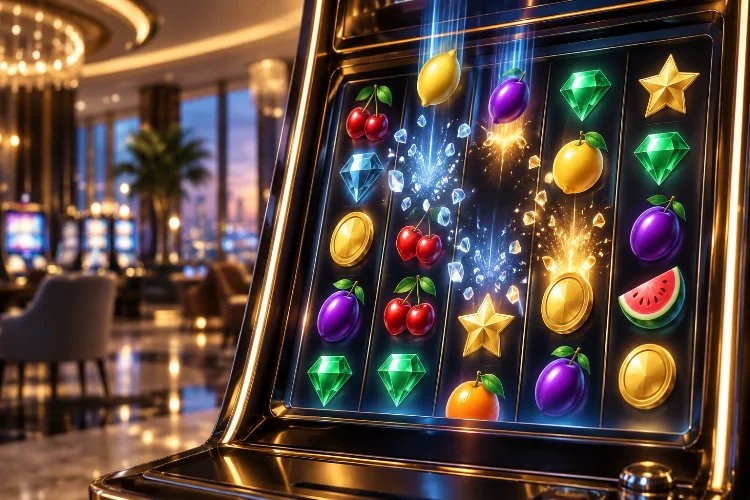

How Unequal Symbol Probabilities Shape Modern Digital Slots
A digital slot might show a diamond, cherry, wild, bell, and jackpot symbol at exactly the same visual size. That does not mean they have the same chance of appearing. Behind the animation, developers can assign very different mathematical weights to individual symbols.
These Unequal Symbol Probabilities are one of the foundations of modern slot design. Instead of every visible symbol receiving an identical probability, virtual reels and mapping tables allow common symbols to occupy much larger portions of the outcome space than premium icons.
Historical slot-machine patents describe exactly this idea: several random-number values can be mapped to the same reel stop, giving developers control over how frequently particular positions are selected without changing the physical appearance of the reel.
The result is a game where what you see and what is statistically likely are two different things.
Weighted Reels Are Different From Equal Reels
Start with the simplest possible model.
Imagine one virtual reel has ten stops and every stop is equally likely.
If a diamond appears once, its probability is:
1 ÷ 10 = 10%
If a cherry appears four times:
4 ÷ 10 = 40%
The cherry is therefore four times as likely to appear.
Digital slots can take this idea much further. Instead of relying only on visible symbol positions, developers can map a larger pool of random values to those positions.
A gaming patent describing virtual reel systems explains that multiple random numbers can point to the same reel symbol. Another describes distributing a large number of possible random outcomes disproportionately across the available symbols.
That is the basic mechanism behind symbol weighting.
Virtual Stops Create Fine-Grained Probability Control
Suppose a reel visually contains 20 symbol positions.
A purely equal model would give each unique position a probability of 1 in 20, or 5%.
Now imagine the game internally uses 1,000 virtual outcomes.
A common cherry might receive 180 outcomes.
A bell might receive 80.
A premium diamond might receive only 10.
Their probabilities become:
Cherry: 18%
Bell: 8%
Diamond: 1%
The reel can still display all three symbols at roughly the same visual scale.
The probability architecture sits underneath that presentation.
Patent documentation provides examples where disproportionately distributing a thousand random numbers among virtual reel symbols can significantly alter the literal probability suggested by the visible reel.
This gives developers much finer control than a short mechanical reel could provide.
Different Reels Can Weight the Same Symbol Differently
One interesting detail is that the same symbol does not need the same probability on every reel.
Imagine a five-reel slot where the jackpot crown appears with these probabilities:
Reel 1: 5%
Reel 2: 4%
Reel 3: 3%
Reel 4: 2%
Reel 5: 1%
If the jackpot requires one crown on every reel, the simplified probability becomes:
0.05 × 0.04 × 0.03 × 0.02 × 0.01
That equals approximately 1 in 8.33 million.
This is why visually seeing a crown frequently on the first few reels does not tell you how likely the complete premium combination is.
Developers can make early reels relatively generous while keeping the final required symbol much rarer.
The graphics look symmetrical.
The probablity model does not have to be.
RNG and Weighting Perform Different Jobs
The random number generator is sometimes described as though it directly decides whether a spin should win.
A better way to picture the process is:
RNG output → mapping system → reel position → symbols → paytable result
The UK Gambling Commission formally defines mapping as the process of using an RNG result to select an outcome, giving a reel-strip symbol as an example.
Its technical standards also require RNG outputs and game results to be acceptably random and prohibit adaptive behaviour in which recent outcomes dynamically compensate for earlier play.
So randomness determines which valid point in the outcome space is selected.
The weighting model determines how much of that outcome space belongs to each symbol.
Those are related but seperate functions.
Weighted Symbols Help Engineers Build RTP
Symbol probabilities matter because every winning combination contributes to theoretical Return to Player.
Consider a simple premium combination that appears once every 2,000 spins and pays 200× stake.
Its expected-return contribution is approximately:
1/2,000 × 200 = 10%
If developers double its probability without changing the payout, its contribution would roughly double too.
Something else would need to change if the total target RTP remained fixed.
Gaming Laboratories International explains that theoretical RTP analysis evaluates winning combinations and paytable information to calculate the expected percentage returned over the long run.
Weighted reels therefore become one of the main engineering tools for controlling how individual prize categories contribute to total return.
Weighting Also Shapes Hit Frequency
Suppose developers want more frequent small wins.
They could increase the probability weights of lower-value symbols that form common combinations.
Hit frequency would probably rise.
However, if the overall RTP target remains unchanged, those extra hits cannot simply create additional expected value from nowhere.
Their payouts might need to be smaller, medium prizes could become less frequent, or the probability of premium outcomes might be reduced.
This balancing process explains why a slot can generate lots of paying events without necessarily having a higher RTP.
Frequency measures how often something happens.
Return measures how much value those events contribute.
They are not the same measurement.
Rare Symbols Can Increase Volatility
Now imagine moving more of the game’s theoretical return toward symbols with extremely low probability.
The slot may still have the same overall RTP, but a greater proportion of that return now depends on rare events.
Short-term results become more uneven.
This is how weighting can contribute to volatility.
A game where premium symbols appear relatively frequently may distribute returns more smoothly. A model where those symbols are extremely rare but pay huge prizes can create long losing stretches punctuated by occasional large outcomes.
GLI-19 specifically requires that, for spinning-reel games, the mathematical probability of symbols appearing must remain consistent with the game design and be accurately implemented.
The volatility players experience is therefore not random design noise.
It emerges from the underlying probability distribution.
Visible Near-Misses Do Not Reveal Real Odds
Weighted reels also explain why visual intuition can be misleading.
Suppose the jackpot requires three premium symbols and two appear on the screen.
The third reel may stop one position away from another premium symbol.
Visually, that looks extremely close.
Mathematically, however, “one position away” does not necessarily mean the winning stop had nearly the same probability.
Virtual mappings can give neighbouring visible stops very different weights. A premium position might represent only a tiny fraction of the random-number space while adjacent ordinary symbols represent much larger ranges. Virtual-reel patents explicitly describe this kind of unequal mapping.
Physical distance on an animated reel is therefore not the same thing as statistical distance.
That distinction is suprisingly important.
Weighted Reels Do Not Mean the Game Is Adjusting to You
There is also a major difference between fixed unequal probabilities and adaptive outcomes.
A slot can legally be designed so that Symbol A has a 20% probability and Symbol B has 0.5%.
Those probabilities are unequal by design.
That does not mean the machine should start changing them because a specific player has recently won or lost.
UK Gambling Commission standards state that outcomes must be acceptably random and specifically prohibit adaptive or compensated behaviour for random outcome generation.
This means a properly implemented random game follows its defined probability architecture rather than deciding that a particular user is “due” for a win.
The difference between weighting and manipulation is important.
Weighting sets the probability model.
Randomness selects within it.
Unequal Symbol Probabilities allow digital slots to make some symbols common and others extremely rare without changing their visual importance. Virtual stops, RNG mapping, reel-specific weights and paytables work together to build RTP, hit frequency and volatility.
When analysing a slot, remember that equal-looking symbols do not imply equal odds—the real mathematics lives in the hidden mapping behind the reels.